actas
Kilt meets kirpan

One of photographer Hermann Rodrigues’ favourite jokes is about how the Tamil English accent comes from Scotland. “Just think about the way Tamilians pronounce mah-rige (marriage) or roll the word girl-uh (girl) — it sounds so Scottish!” he says, laughing.
There are many more connections between South Asia and Scotland — apart from the shared love of Scotch, of course.
Over the last 23 years, Rodrigues and his camera have travelled across Scotland in search of these
“crossovers” – interchanges between South Asians and Scots. He will be showing his work in an
exhibition titled ‘Broon Scots’ at the University of Edinburgh this month.
The 52-year-old Rodrigues, who was born and educated in Jaipur, moved to Scotland over two decades
ago with his wife. “When I first came here, I was amazed by the number of South Asians here. But
despite so many differences – of religion, culture, etc, – they were being put under the same
umbrella of ‘ Asians’.” His endeavour is to bridge the gap between what the Scots know about South
Asians and what South Asians know about each other and their roots. “When I visited Patna in East
Ayrshire, I was surprised to learn its residents had no idea about the origin of its name,” he says of the
small village named in the early 19th century by landowner William Fullarton after his birthplace in
Bihar.
He’s made several serendipitous discoveries over the years – a secondary school in St Andrews called
Madras College founded in 1833 by Andrew Bell, a Scottish Episcopalian priest who pioneered the
Madras System of Education. “Not many know the monitorial system of education (brighter or older
students tutoring others) has its origins in Tamil Nadu,” says Rodrigues. Then there’s the Fyrish
monument, built by a British general of Scottish origin, Hector Munro. In 1781, Munro captured
Negapatam, a Dutch outpost in Tamil Nadu, for the British who were battling France (a US ally) in the
American Revolutionary War. “Munro commissioned this monument inspired by Negapatam gate to
generate work for the locals,” says Rodrigues of the stone structure that stands atop Fyrish Hill near
Alness, Easter Ross. His dogged pursuit of South Asian history led Rodrigues on a five-hour ferry
journey to the Western Isles in Scotland where he found, among a Gaelic-speaking community of 5,000
inhabitants, descendants of immigrants from what is today Pakistan. “Can you imagine the courage it
took for them to travel across the ‘kala paani’ over 70 years ago, to this cold, rough place to sell
woollens?” he asks.
Other revelations include a Vellore Road in Falkirk town. “The Christian Medical College in Vellore, TN,
was founded by the Scots. The constant stream of missionaries and educationists travelling between
both countries explains why so many streets, buildings here have Indian names,” he says. His photos
also capture how the immigrants have embraced Scottish culture while retaining their roots. At
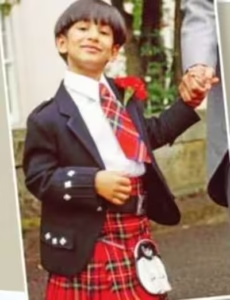
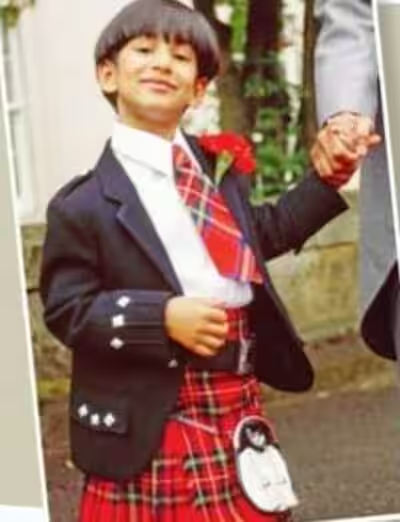
traditional weddings, for instance, attendees often sport kilts, dance to bagpipes and enjoy tandoori
salmon on the menu. There is even a ‘Singh’ tartan -sky-blue background with a green and red plaid –
that can be worn by any Asian of Scottish descent. Cultural outreach through melas and public
celebrations is also a growing phenomenon.”Holi has been brought in by the student community
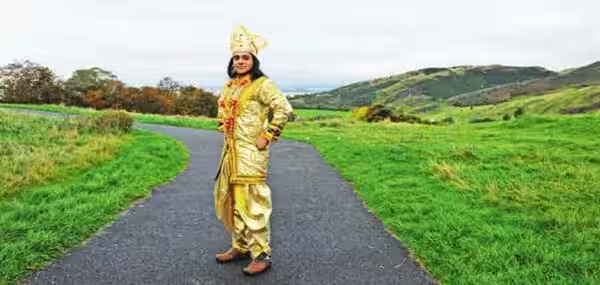
Rodrigues captures an Indian on his way to Dussehra celebrations in Edinburgh.
Although South Asians are Scotland’s largest minority (2.7% are Asian, Scottish-Asian or British-Asian,
according to the 2011 census), there are no signs of ethnic tensions like in England. “It could be
because the immigrant community is not very large and seen as less threatening,” says Rodrigues.
Even the term ‘ Broon’ -a colloquial Scottish word for brown -is not derogatory, he says.